


Key Takeaways:
- RBM prioritizes risks that could affect participant safety, participant rights, or critical trial data.
- Risk assessments guide the monitoring plan and should be reviewed as the study progresses.
- Key risk indicators (KRIs) and quality tolerance limits (QTLs) serve different purposes in risk oversight.
- Centralized, remote, and on-site monitoring can complement one another.
- Effective RBM requires clear responsibilities, documented decisions, and timely follow-up.
Introduction
Clinical trials generate data across multiple sites, involve different research teams, and require careful oversight from the first participant visit to study completion. A missed safety assessment at one site may require a different response from a minor administrative delay at another.
Monitoring every activity equally may not be effective. Research teams need to identify which issues pose the greatest risks and prioritize them accordingly.
Risk-based monitoring in clinical trials provides a structured way to do this. It helps sponsors, contract research organizations (CROs), and clinical research teams plan monitoring activities around the risks that matter most.
Understanding how risk-based monitoring (RBM) works, which tools support it, and how monitoring plans adapt over time can help teams maintain effective oversight without treating every data point as equally important.
Quick Answer
Risk-based monitoring in clinical trials is an approach that directs monitoring activities toward the processes, sites, and data most likely to affect participant safety or the reliability of trial results. It combines risk assessment, centralized data review, targeted source data verification, and ongoing oversight to help research teams identify and address important issues throughout a study.
Why Is Risk-Based Monitoring Important?
The purpose of risk-based monitoring in clinical trials is to strengthen oversight by focusing on the issues that matter most. The connection between risk-based monitoring and patient safety is particularly important because missed safety assessments, delayed follow-ups, or recurring protocol deviations may require timely investigation and corrective action.
Consider a trial where one site consistently misses scheduled safety assessments, while another submits routine laboratory results a few days late. Both issues need review, but the missed safety assessments may require more urgent investigation because they could affect participant protection.
The main advantages of risk-based monitoring include:
- Better prioritization: Teams focus on risks with potentially serious consequences.
- Earlier issue detection: Reviewing data patterns can reveal problems that individual site visits may not identify quickly.
- More appropriate resource use: Monitoring effort can be adjusted to the needs of each study and site.
- Stronger oversight: Documented findings and follow-up actions help teams maintain accountability.
These benefits depend on sound risk assessment and timely action. RBM does not automatically prevent protocol deviations or guarantee lower trial costs.
Key Risk-Based Monitoring Principles
The key risk-based monitoring principles are easy to remember. Each one ties back to the quality-by-design and proportionate risk-management approach described in ICH E6(R3).
- Prioritize what matters: Identify processes and data that are critical to participant safety and reliable results.
- Match oversight to risk: Choose monitoring activities according to the study’s specific risks rather than applying the same intensity everywhere.
- Use multiple sources of information: Review site performance, safety information, protocol deviations, and relevant data trends.
- Act on findings: Define who investigates issues, who approves corrective actions, and how resolution is documented.
- Adapt as the study changes: Reassess risks when new information, recurring issues, or changes in trial conduct warrant it.
These principles form the basis of a practical risk-based monitoring framework.
What Are the Main Components of a Risk-Based Monitoring Framework?
A monitoring framework turns risk assessment into specific oversight activities. Four important components are risk indicators, quality tolerance limits, centralized review, and targeted verification.
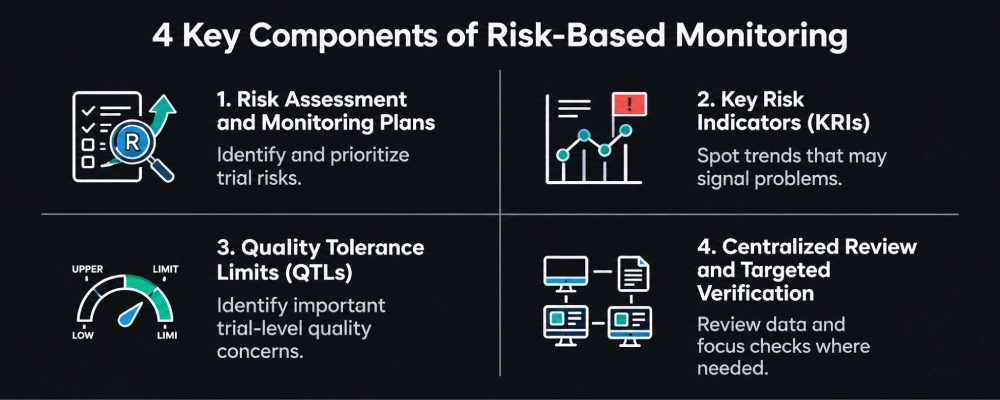
1. Risk assessment and monitoring plans:
Teams identify possible failures, assess their likelihood and potential impact, and decide how to control them. The resulting monitoring plan should describe monitoring methods, responsibilities, review frequency, escalation procedures, and documentation requirements.
2. Key risk indicators (KRIs):
KRIs help teams identify trends that may signal an emerging problem. For example, a rising rate of unresolved data queries at one site may warrant further review.
A KRI is a signal to investigate, not proof of misconduct or poor-quality research. Teams should interpret it alongside the study context and other evidence.
3. Quality tolerance limits (QTLs):
QTLs are predefined limits for certain important trial-level parameters. They help teams identify when variation in a critical aspect of the study may require evaluation.
Unlike a site-level KRI, a QTL generally concerns a broader trial-level quality parameter. Exceeding a QTL should prompt assessment of the issue and its potential impact, rather than an automatic conclusion that the trial has failed.
4. Centralized review and targeted verification:
Centralized monitoring allows teams to review data across sites and identify unusual patterns. Remote interactions and on-site visits can then be used according to the issue and the level of oversight needed.
Source data verification (SDV) and source document review (SDR) can also be targeted toward critical information. This does not mean eliminating essential checks or overlooking safety-related data.
How Does Risk-Based Monitoring Work in Practice?
Risk-based monitoring is an ongoing process, not a one-time assessment completed before recruitment begins. It also requires clear responsibilities, timely communication, and coordinated clinical trial operations across study teams and sites.
- Identify critical factors
Determine which participant protections, trial procedures, and data points are essential to the study’s reliability. - Assess potential risks
Consider what could go wrong, how likely it is, and what the consequences might be. - Develop the monitoring plan
Assign monitoring activities, responsibilities, review schedules, and escalation criteria. - Review incoming information
Examine relevant data, site performance, protocol deviations, and safety information. - Investigate warning signs
Establish whether an unusual pattern reflects a genuine issue, a data problem, or another explanation. - Take appropriate action
Follow up with the site, document findings, and implement corrective and preventive actions when warranted. - Reassess the risks
Update the monitoring approach when findings or changes in the study justify it.
For example, repeated missing safety assessments at a trial site should prompt a review of the affected participants, the reasons for the omissions, and any potential safety implications. The team can then determine whether additional site oversight, staff retraining, or other corrective action is needed.
The response should be proportionate to the findings, documented, and followed through to resolution.
Following these steps helps trial teams focus their monitoring efforts where they matter most. But how does this approach differ from traditional monitoring? The key difference lies in how monitoring activities are prioritized and adjusted throughout the study.
Risk-Based Monitoring vs. Traditional Monitoring
Both approaches support trial oversight, but they differ in how monitoring effort is planned and prioritized.
| Aspect | Traditional Monitoring Approach | Risk-Based Monitoring |
|---|---|---|
| Monitoring Focus | May rely on routine, predefined checks | Prioritizes critical risks |
| Data Verification | May use broader, routine SDV | Targets verification according to risk |
| Site Visits | Often follow a planned schedule | Frequency and intensity can adapt to risk |
| Data Review | May emphasize individual records and visits | Can combine site-level and centralized review |
| Follow-up | Responds to identified findings | Uses ongoing risk assessment to guide action |
These approaches are not mutually exclusive. RBM can include routine checks, targeted SDV, remote reviews, and on-site visits when appropriate.
Risk-Based Monitoring Guidelines and Best Practices
The FDA’s 2023 guidance outlines monitoring plans and procedures for documenting, communicating, and addressing findings. ICH E6(R3) emphasizes quality by design and proportionate risk management.
To apply these principles in practice:
- Identify critical risks before selecting monitoring activities.
- Set clear thresholds for risk signals and define when to escalate findings.
- Clarify the responsibilities of monitors, investigators, and study teams.
- Document monitoring findings, decisions, and corrective actions.
- Verify that corrective actions resolve the underlying issues.
- Update the monitoring plan as risks change throughout the trial.
The right monitoring strategy depends on the protocol, study population, investigational product, data collection methods, and applicable regulatory requirements. A monitoring plan should reflect these factors rather than follow a generic template.
These practices also depend on how well each research site is prepared to conduct the study. Site capabilities, staff responsibilities, and established procedures can influence trial execution and the risks that arise. Addressing these factors begins with site enablement, which helps prepare research sites for study activities.
Also Read: Quality Assurance vs Quality Control in Clinical Trials
How Minerva Research Solutions Supports Risk-Based Monitoring in Clinical Trials
Risk-based monitoring only works when someone acts on what the data shows. At Minerva Research Solutions, we help sponsors and research teams do exactly that through clinical trial monitoring and quality assurance built around each study’s critical risks.
Our team supports you with:
- On-site and remote monitoring matched to site-level risk.
- Compliance checks that catch issues before they grow.
- SOP review to close process gaps early.
- Audit support that keeps findings documented and resolved.
We work within Pakistan’s regulatory environment, backed by our experience in US trials. You can learn more about our team and see how we approach managing clinical trials in Pakistan.
Planning a study in Pakistan? Talk to us about monitoring support tailored to your protocol and risk profile.
MONITORING & QUALITY ASSURANCE
Want Greater Confidence in Your Trial Quality? Strengthen oversight, compliance, and study performance with Minerva.
Conclusion
Risk-based monitoring in clinical trials helps research teams direct attention toward issues that could affect participant safety, trial conduct, and data reliability. Its effectiveness depends on meaningful risk assessment, suitable monitoring methods, clear responsibilities, and consistent follow-up.
When teams review risks throughout a study and respond appropriately to emerging issues, they can maintain more focused oversight without treating every site or data point the same way.
FAQs
What is the main purpose of risk-based monitoring in clinical trials?
Its main purpose is to focus monitoring on risks that could affect participant rights and safety or the reliability of trial results, allowing teams to prioritize oversight and address important issues.
What are the main advantages of risk-based monitoring?
RBM can improve risk detection, help teams allocate monitoring resources appropriately, and support more targeted oversight. These benefits depend on effective implementation.
Does risk-based monitoring eliminate on-site visits?
No. On-site visits remain useful when the risks, findings, or activities of a study require direct site oversight. RBM helps determine which monitoring methods are appropriate.
What is the difference between KRIs and QTLs?
KRIs help identify potential risks or emerging trends, often at the site or operational level. QTLs are predefined limits for important trial-level quality parameters. Both can prompt further investigation.
Does risk-based monitoring replace on-site monitoring?
No. RBM uses centralized, remote, and on-site monitoring together. Centralized review can flag unusual patterns across sites, and the team then chooses the right follow-up, whether a remote interaction or an on-site visit. The choice depends on the issue and the level of oversight needed.